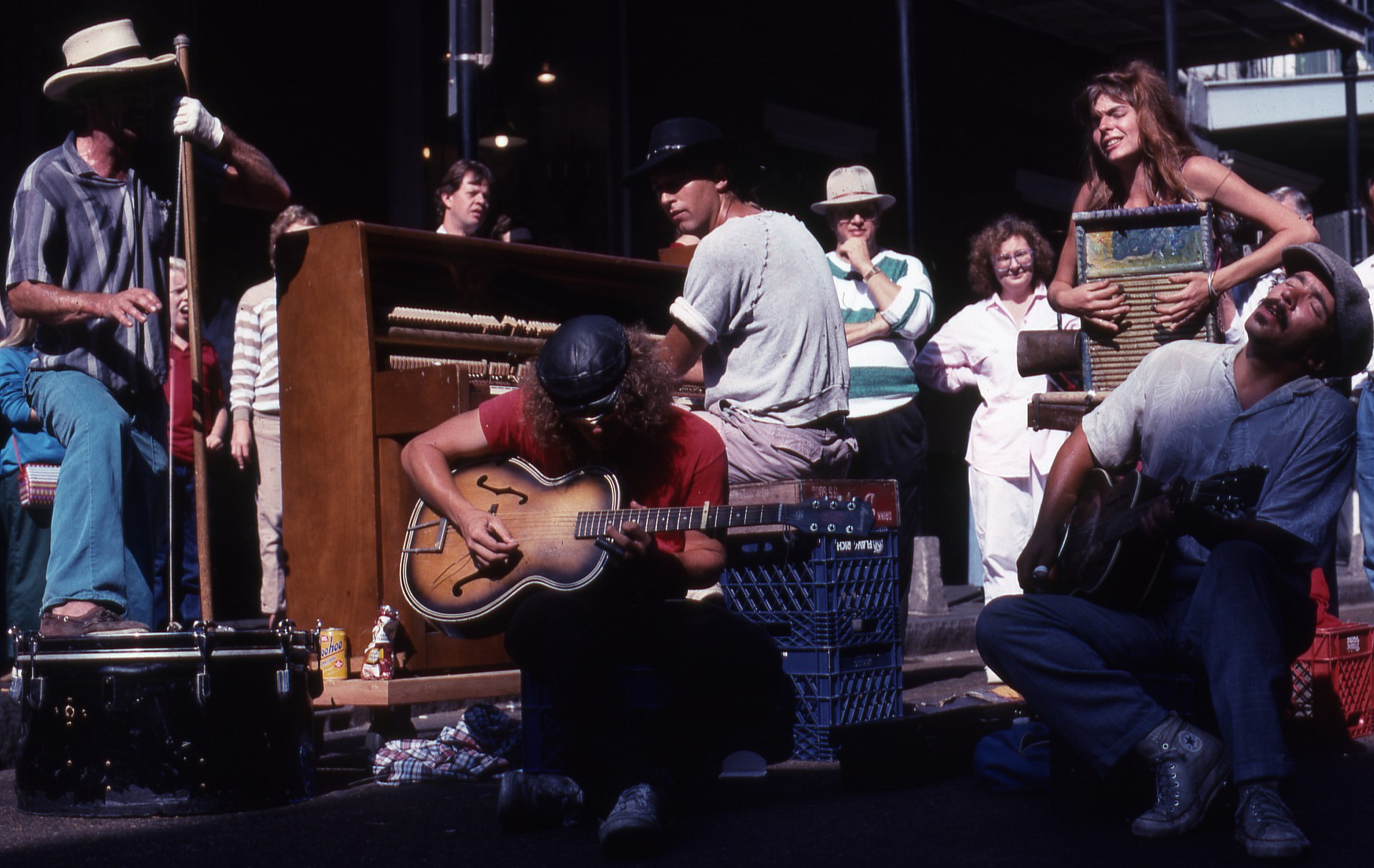
The Stellarterm Sessions began, like most small music projects, by accident. In January 2020 we had just signed a lease on a second-floor room above a restaurant on St Peter Street in the French Quarter of New Orleans, intending to use it as an office. The room was small, carpeted, and unexpectedly quiet for a space in the heart of the tourist district. A pianist friend — Joseph Ladnier, who was then playing evenings at a nearby piano bar — stopped by one afternoon to look at the space and mentioned, half-jokingly, that it had the acoustics of a recording studio. A week later we had bought two microphones and a modest audio interface. The following Thursday Joseph came back with an upright bass player, and we recorded what became the first of the Stellarterm Sessions. Five and a half years and sixty monthly evenings later, that is still what we do.
This article is an account of the Stellarterm Sessions — what the programme is, what we have recorded in it, and what it has quietly become since 2020.
The name
Readers occasionally write in asking where the name "Stellarterm" came from. The short answer is that we do not entirely remember. The room on St Peter Street has a single high window facing north; on clear winter evenings the first stars are visible by the time we start rolling tape; an early note in a planning document describes "the stellar term" of the year — the handful of cold weeks in January and February when the Quarter's usual summer haze lifts and the night sky is briefly clear. The phrase contracted, as phrases tend to in working conversation, to "Stellarterm." The word stuck. By the third session it had become the name.
The naming is worth a paragraph because, in small-label work, names matter more than they should. The Stellarterm Sessions are in every meaningful sense the same recordings they would have been under any other name; but readers, listeners, and — eventually — the musicians themselves treat the programme differently because it has a name and a continuity. Our monthly session is the Stellarterm; the archive of sixty recordings is the Stellarterm archive; the engineer, the room, the specific cup of coffee we bring on Thursdays are all part of the apparatus. Naming something, we have come to believe, changes how you work on it.
How the sessions are recorded
The technical arrangement has stayed broadly constant across the sixty recordings. The room on St Peter Street is approximately four metres by six, with a hardwood floor under a worn rug and a single high window. Acoustic treatment is minimal: two sound-absorbing panels on the west wall, a heavy curtain over the window, and, in summer, a small humidifier working against the famous New Orleans moisture.
The signal path is:
- Two large-diaphragm condenser microphones in an XY pair for the room sound
- One ribbon microphone, placed at the instrument being featured on the evening
- A single DI box for any electric or amplified instrument
- A four-channel pre-amp into a modest audio interface into a laptop
- Record direct-to-stereo at 24-bit/96 kHz, no multitrack
The direct-to-stereo decision was a conscious one, made in the first month of the Stellarterm programme. Multitrack recording gives you options in the mix; direct-to-stereo forces you to commit during the take. For a programme that records a single evening per month, the commitment is, in our view, the point. The musicians play the room; the room plays back; what we capture is one specific evening and not a construction.
What we have recorded
The sixty Stellarterm Sessions recorded between February 2020 and the present have documented, between them, approximately forty-five different musicians, playing between them approximately twelve hundred individual pieces of music. The documentation includes:
- New Orleans piano tradition. Joseph Ladnier (our first Stellarterm participant) has returned for eight further sessions across the six years. Two other pianists — Eleanor Bonnet and Patrice Villere — have each recorded three sessions. The tradition they are playing in, broadly, is the line from Professor Longhair through James Booker to present-day French Quarter piano.
- Brass band ensembles. Seven sessions have documented small-format brass ensembles — typically trumpet, trombone, sousaphone, snare, bass drum, and occasionally clarinet. These are rearrangements of second-line material for a recording room rather than street performance; the difference is interesting and is described at some length in our companion piece on second-line tradition.
- Vocal and singer-songwriter work. Eleven sessions have featured vocalists, some accompanied by piano, some by small string ensemble. The material ranges from original songs to reinterpretations of the American Songbook repertoire that New Orleans performers continue to favour.
- Clarinet and reed traditions. Six sessions have centred on clarinet players working in the traditional-jazz idiom. The clarinet sessions are, for reasons we do not fully understand, the Stellarterm recordings that tend to receive the strongest response from listeners outside New Orleans.
- Mixed and experimental evenings. The remaining approximately eighteen sessions have been harder to classify — piano-and-poet evenings, string-quartet evenings, a memorable evening of solo banjo, one entirely improvised evening with four musicians who had not previously met.
The archive
The Stellarterm archive — the set of sixty master recordings and the associated paperwork — lives on two mirror drives in the St Peter Street room and on a third drive in a fire-safe at Elliott's home in Faubourg Marigny. A written log-book records the personnel, instrumentation, room conditions, and microphone setup for each session; this is the register we consult when readers write in asking about a specific evening.
Access to the archive is not public. We have resisted, over the years, the several suggestions that we should. The Stellarterm Sessions were conceived as a recording programme, not a streaming service, and the decisions we make about how the material circulates are — we think — part of what gives the programme its specific character. Selected recordings have been released on modest physical editions of between 100 and 300 copies, through channels we describe in the Label section of our About page.
What the Stellarterm programme has become
The Stellarterm Sessions were supposed to be a six-month experiment. They have, without our fully noticing it happening, become something else: a continuous six-year record of a particular corner of the New Orleans music scene, held by two editors in a small French Quarter room. Musicians who play a Stellarterm session tend, on average, to play two or three more over the following years; the list of Stellarterm regulars is now a rough but recognisable map of the musicians Elliott and I spend the most time listening to in the city.
The Sessions have also, quietly, become a point of reference for some of our correspondents. Musicians preparing a recording of their own sometimes write asking about our microphone setup, our room, our approach to direct-to-stereo. Independent labels in other American cities occasionally write asking about the programme as a model. We answer what we can answer; we decline what we cannot; and we keep recording.
The sixty-first session
At the time of writing, the sixty-first Stellarterm Session is scheduled for the final Thursday of this month. The featured musician is — by long-standing convention — not publicly announced in advance, but regular readers of our correspondence will have a reasonable guess. The room has been swept; the microphones have been tested; the sound-absorbing panel on the west wall has been re-glued after a summer of Louisiana humidity.
We will record. We will listen back. We will, as we have done for the past five and a half years, add a new entry to the Stellarterm logbook. The programme continues, slowly, in the way small programmes sometimes do.
For correspondents
Readers who have questions about the Stellarterm Sessions — technical questions about the recording arrangement, editorial questions about the programme, or simply letters from musicians who would like their name considered for a future session — are always welcome to write to us at editor@fattuesdayrecords.com. We answer most serious correspondence within two working days. We do not take requests for specific recordings from the archive; we do sometimes agree to answer specific technical questions in a subsequent article.